Best Air Purifier UK: A Room-by-Room Buying Guide for 2026
Choose the best air purifier for a UK room by particle problem, airflow, noise and filter cost. Includes a clear guide to combined dehumidifier-air-purifiers for small flats.
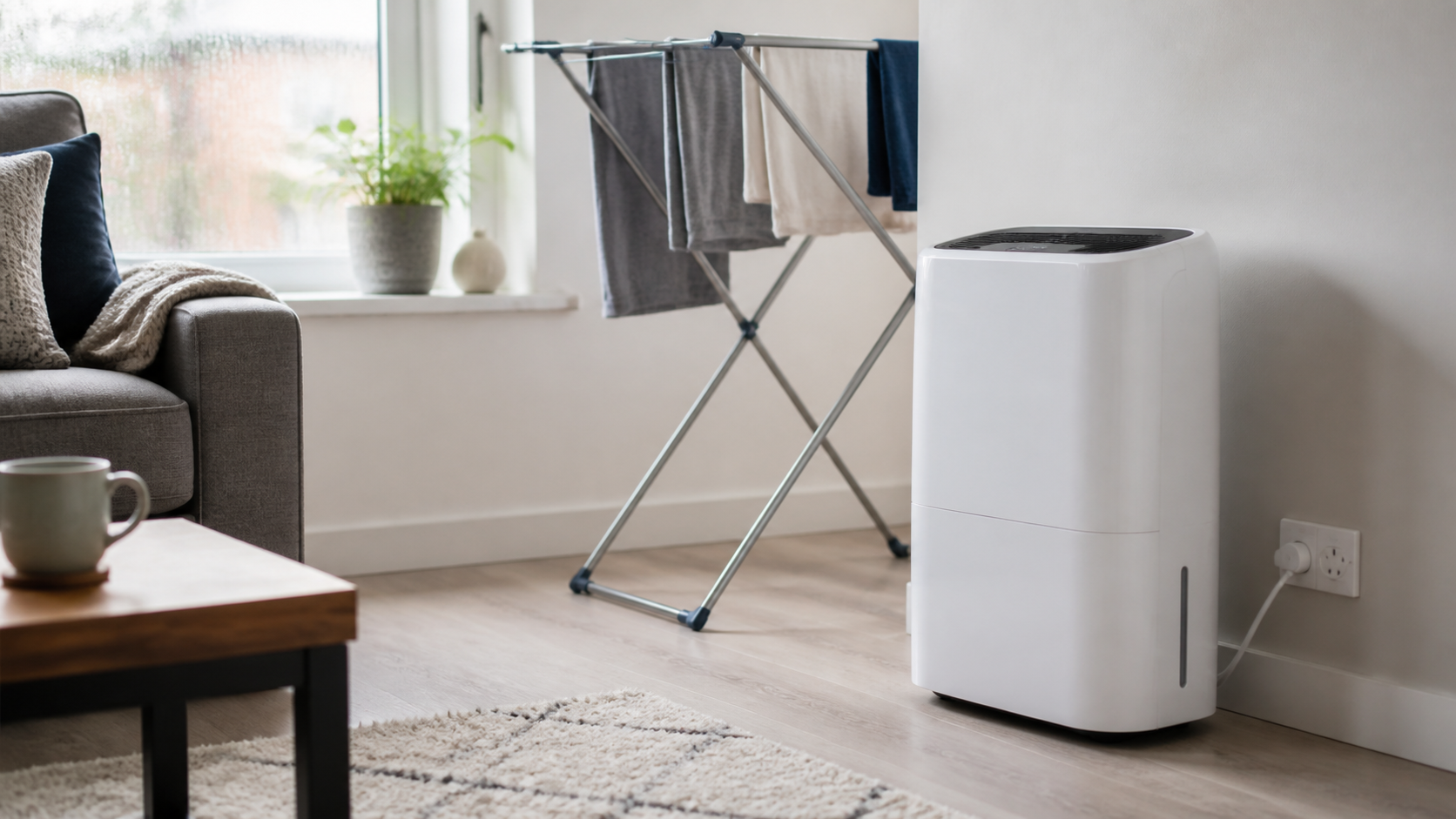
The best air purifier for a UK home is not the one with the most modes. It is the one that moves enough air through an appropriate filter at a noise level and replacement-filter cost you can live with. Start with the pollutant and room, then compare airflow, filter evidence, sound and maintenance.
For a small flat with condensation or indoor laundry, a combined dehumidifier and HEPA purifier can solve two distinct problems in one footprint. But it remains important to separate them: dehumidification removes moisture; filtration captures airborne particles. One function does not substitute for the other.
The quick choice
| Main problem | First response | Purifier role |
|---|---|---|
| Outdoor particles, pollen, pet dander | Reduce sources where possible; ventilate appropriately | HEPA filtration can reduce airborne particles |
| Condensation and indoor laundry | Control moisture, heat and ventilation; consider a dehumidifier | Purifier mode does not remove water vapour |
| Cooking fumes and gases | Use effective extraction and ventilation | Particle filters alone do not remove all gases |
| Persistent mould | Find and fix moisture source; clean/remediate safely | A purifier may reduce airborne particles but does not cure damp |
| Odours/VOCs | Source control and ventilation | Activated carbon may help, depending on quantity and design |
An air cleaner is an addition to source control and ventilation, not permission to ignore them.
Choose by room, not whole-home promises
Measure the room’s length, width and ceiling height. Multiply them to get cubic metres. A purifier needs to circulate a meaningful volume of clean air through that space, and real placement, filter loading and fan setting affect performance.
Look for a published clean-air delivery rate (CADR) or a clearly stated airflow at the setting you will actually use. A maximum fan figure is less useful if the sound means you always run the machine on low. When no CADR is published, compare carefully and avoid converting raw fan airflow into a guaranteed clean-air result.
For sleep, test the night-mode sound in the room, not just the number on a box. A tonal motor noise can be more noticeable than a slightly higher, smooth airflow sound.
HEPA: what the label can and cannot tell you
HEPA describes particle filtration performance under a standard or classification; it does not prove the complete appliance is leak-free or correctly sized. Check:
- the exact filter class claimed and who supplies it;
- whether air can bypass the filter;
- replacement interval and current UK price;
- whether replacements are consistently available;
- how the pre-filter is cleaned;
- whether the manufacturer publishes whole-appliance performance.
HEPA particle filtration is relevant to dust, pollen and some other airborne particles. It does not remove humidity. A thin carbon sheet may reduce some odours, but it should not be treated as comprehensive gas or VOC control without evidence for the media quantity and test method.
Running cost is filter cost plus electricity
Compare annual ownership rather than checkout price:
- appliance price;
- watts at the fan setting you expect to use;
- hours per day;
- replacement filter price and interval;
- pre-filter cleaning time;
- warranty and repair route.
A cheap purifier with unavailable filters is a short-lived appliance. A high-powered unit run quietly at medium speed may deliver more useful clean air than a smaller unit that is too noisy at maximum.
Small flats: when a combined machine makes sense
A combined dehumidifier-purifier earns its floor space when the flat has both excess humidity and a particle-filtration need. It is especially practical for indoor laundry, window condensation and limited storage.
The MeacoDry Arete Two 12L official page describes a compressor dehumidifier with a dust filter and H13 HEPA filter, a dedicated air-purification mode, three fan speeds of 80, 100 and 140 cubic metres per hour, dimensions of 472 x 319 x 237 mm, and stated sound levels of 35, 38 and 44 dB(A). Meaco positions the 12L model for flats and one- to three-bedroom homes, including operation in spaces below 10 degrees C.
Those are manufacturer specifications, not an independent ranking. Use them to test fit:
- Is 472 x 319 x 237 mm acceptable with clearance for airflow?
- Is the 10.9 kg stated weight manageable if you move it?
- Will the chosen fan setting be tolerable in the bedroom or living room?
- Does the airflow suit the actual room volume?
- Can you buy the correct replacement H13 filter?
The current MeacoDry Arete Two 12L product page should be checked for today’s price, included filter and warranty before ordering.
Dehumidifier versus purifier
Choose dehumidification first when
- water collects on windows;
- laundry takes a long time to dry indoors;
- relative humidity remains high;
- damp is driven by moisture load rather than airborne particles.
Read the UK dehumidifier buying guide and our compressor versus desiccant guide for temperature-dependent choices.
Choose particle filtration first when
- the room is dry enough but affected by pollen or particle ingress;
- pet dander or ordinary airborne dust is the main concern;
- the purifier has credible clean-air performance for the room.
Choose a combined unit when
Both needs are real, floor space is limited and the combined appliance performs acceptably in each mode. Do not assume simultaneous labels mean simultaneous maximum performance; check the manual.
Placement and daily use
Put the purifier where air can enter and leave without curtains, furniture or walls blocking the openings. The machine needs to mix room air, not clean a small pocket behind a sofa.
Close obvious uncontrolled leakage during an intensive cleaning period, but maintain safe, appropriate ventilation for occupants and combustion appliances. Use kitchen and bathroom extraction for pollution and moisture at source.
Run the appliance long enough to affect the room, and use a setting you can sustain. Clean the pre-filter on schedule and replace the main filter according to condition and manufacturer guidance. Resetting a filter light without replacing a loaded filter does not restore performance.
Claims to treat carefully
- “Removes 99.97%” without the particle size, standard and test context.
- “Medical grade” used as a substitute for whole-appliance evidence.
- A huge room-size claim with no CADR or airflow basis.
- “Kills mould” when the moisture source remains.
- Allergy or asthma treatment promises. A purifier is not a medical treatment.
- Ionisation, plasma or ozone features without clear emissions and safety information.
- Filter-life claims that ignore smoke, pets, construction dust or heavy use.
A one-week acceptance test
Before discarding packaging, define success and record it.
| Check | Day 1 | Day 7 |
|---|---|---|
| Room and setting | ||
| Hours run | ||
| Noise acceptable for sleep/work | ||
| Humidity before/after, if dehumidifying | ||
| Water collected, if applicable | ||
| Pre-filter condition | ||
| Replacement filter source confirmed |
Do not judge particle removal from smell alone. Odour, humidity and particles are different measurements.
Indoor laundry
For laundry, position a dehumidifier so its airflow supports drying without violating clearance instructions. Keep doors/windows managed according to the method and use the timer rather than running blindly. Our guide to the best dehumidifier for drying clothes covers load size and room setup.
A standalone purifier will not dry clothes because it does not condense water from the air. A combined unit can run a laundry mode for moisture and a purification mode for particles, but each function should be assessed on its own evidence.
Frequently asked questions
What is the best air purifier for a bedroom in the UK?
Choose one with credible clean-air performance for the bedroom volume, low enough noise at the required setting, no unwanted light, and affordable replacement filters. Place it with unobstructed airflow.
Is H13 HEPA enough information?
No. It describes the filter class claim, not room sizing, air bypass, noise or replacement availability. Compare the whole appliance.
Will an air purifier stop condensation or mould?
It does not remove water vapour. Address moisture source, heating, extraction and ventilation; use a dehumidifier where appropriate. Mould requires the damp cause to be fixed.
Is a combined dehumidifier-air-purifier good for a small flat?
It can be, when both humidity and particle filtration are genuine needs and the unit’s airflow, noise, dimensions and filter cost fit the room. It saves floor space but does not erase the difference between the two functions.
Should I leave an air purifier on all day?
Continuous operation can improve particle control, but use manufacturer guidance and compare electricity, noise and filter loading. Source control and ventilation still matter.
Bottom line
Choose the best air purifier by pollutant, room volume, usable clean-air performance, noise and filter supply. For a damp small flat, a combined unit such as the Arete Two 12L can be a rational space-saving option, but judge its dehumidification and filtration separately. Fix moisture and pollution sources first; let the appliance support that plan rather than replace it.